We ship Worldwide,
Choose a popular currency:

Chinese latex copying: an in-depth exposé by Latex 24/7 blog

CHINESE LATEX COPYING: AN IN-DEPTH EXPOSÉ BY LATEX 24/7 BLOG
A seemingly massive explosion in Chinese latex copying, involving unapproved replication of designs and imagery from scores of well-known original latex clothing brands, has just been exposed by the latex enthusiast blog site Latex 24/7.
Latex 24/7, which Libidex Blog readers may recall we featured in July for its interview with Libidex MD Simon Rose, is enjoyed for its coverage of celebrity latex-wearing at events and in broadcast media. But its latest story — covering the online marketing of pirated original latex designs under numerous brand names — is a commendably exhaustive journalistic investigation that also deserves your attention.
By coincidence, the exposé appeared in the immediate wake of a high-profile UK controversy over the dropping of prosecutions against two Brits accused of spying for China, which revolved around whether our government viewed China as an enemy or just a ‘challenge’.
Let’s be clear that Latex 24/7’s story does not accuse anyone of spying. But it does suggest that the continuing Chinese disregard for western-style IP (intellectual property) laws and conventions is currently facilitating theft of western latex designers’ IP on an unprecedented scale.
Top of page, left to right: These three Libidex images of Princess Catsuit (Sleeveless and Footless), Cherie Waistcoat and Scarlet Dress Hooded have been stolen by three different Chinese brands to promote their copied designs online
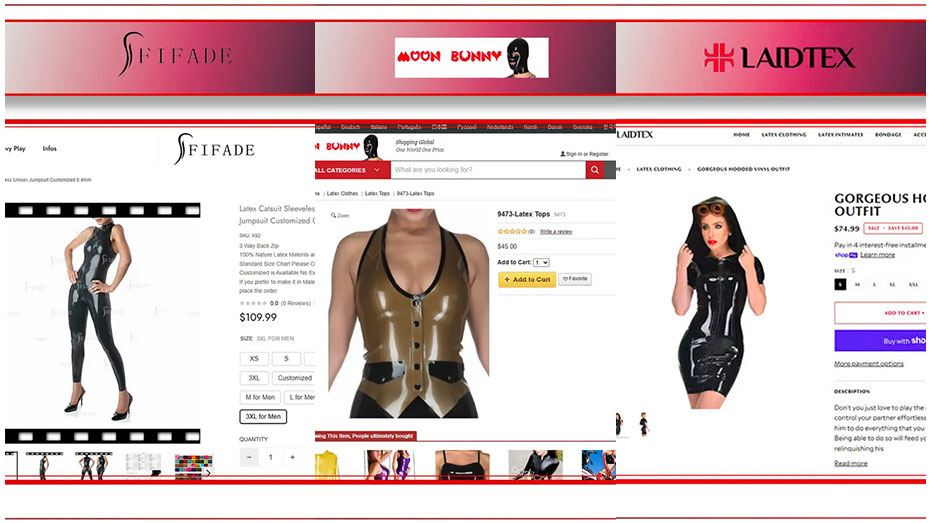
Below: How the three Libidex images above have been used in online product advertising by Chinese brands Fifade, Moon Bunny and Laidtex respectively. These visuals — and our other images below them — all come from graphics created by Latex 24/7 for its in-depth blog story, which provides damning evidence of large-scale Chinese theft of original latex designers’ work
The Latex 24/7 article exposes the online activities of around a dozen brands that have their manufacturing in mainland China or Hong Kong. Some of these, the article explains, use platforms like Spotify to promote their wares, including using stolen images that are sometimes modified but often reproduced unaltered. Some of the brand names and fulfilment locations used might suggest they are western businesses. Verbatim copying/sharing of terms & conditions texts is another frequent behaviour identified in the article.
A couple of the listed brands have been found trading under more than one brand name. And when you look at the similarities across the whole group — including multiple occurrences of the original sources targeted for copying — you might well wonder just how many brands involved in this activity are genuinely separate operations rather than multiple arms of a couple of larger groups.
Latex 24/7’s headline for its story — Revealed: The Secret Network of Online Shops Copying Top Latex Designers! — does suggest it suspects the latter. Either that or the copyists are as happy to copy each other as to copy the original designers, which also does not seem outside the bounds of possibility!
Chinese latex copying is not a new phenomenon: it is often regarded as having its origins with the Latex Catfish company founded almost 20 years ago. Catfish’s early business model — along with a couple of rival companies that followed its lead — involved producing blatant copies of well-known British and European latex labels’ products, and offering them to western latex enthusiasts at cheaper prices. These cheaper prices were possible owing to much cheaper manufacturing costs in China.
Despite complaints from western labels that their intellectual property was being stolen — along with warnings that the Chinese imitations exhibited poor fit and durability owing to inexpert reverse engineering and the low quality of Chinese-made latex sheeting — the low prices inevitably proved attractive to a certain sector of the rubber enthusiast market. For many of these individuals, the ‘hundred dollar catsuit’ was the Holy Grail for which they were saving their pocket-money. It would be fair to say that many tempted by the early Chinese cost-saving promises later suffered disappointment.
Interestingly, Latex Catfish eventually evolved into a much more responsible and respectable originator of latex fashions, to the point where it is today listed in the Latex 24/7 article as a victim of Chinese copying rather than a perpetrator — a situation that is not without irony!
It’s also possible that the existence of cheap Chinese copies of western latex garments would not be such an issue for the ‘legitimate’ latex clothing industry, were it not for the growing popularity of latex in the mainstream over the last decade or so. The media column inches devoted to the public wearing of latex by countless celebrities that powered this popular movement would have been difficult for Chinese latex firms not to see as a business opportunity.
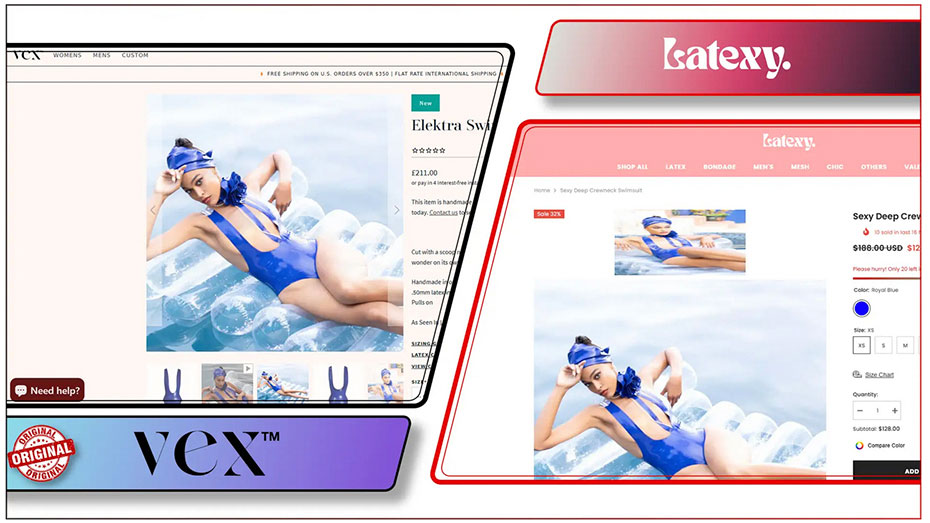
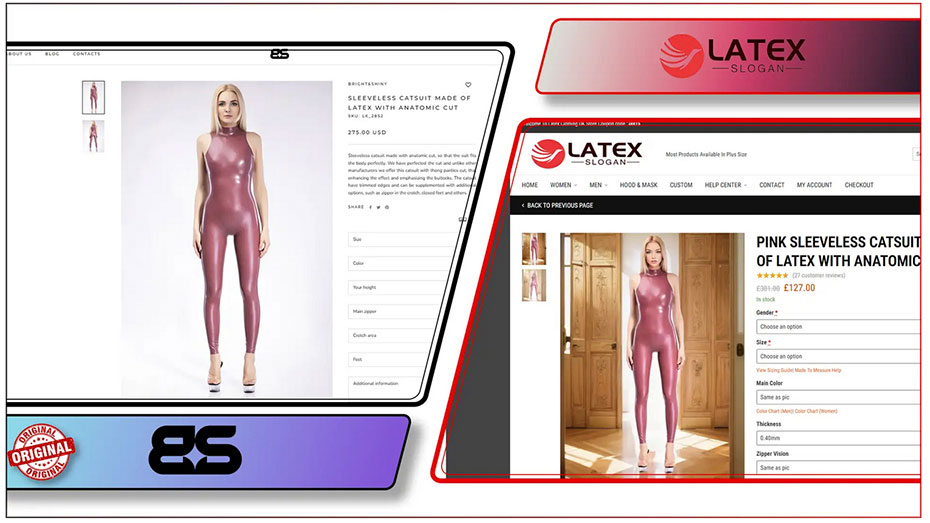
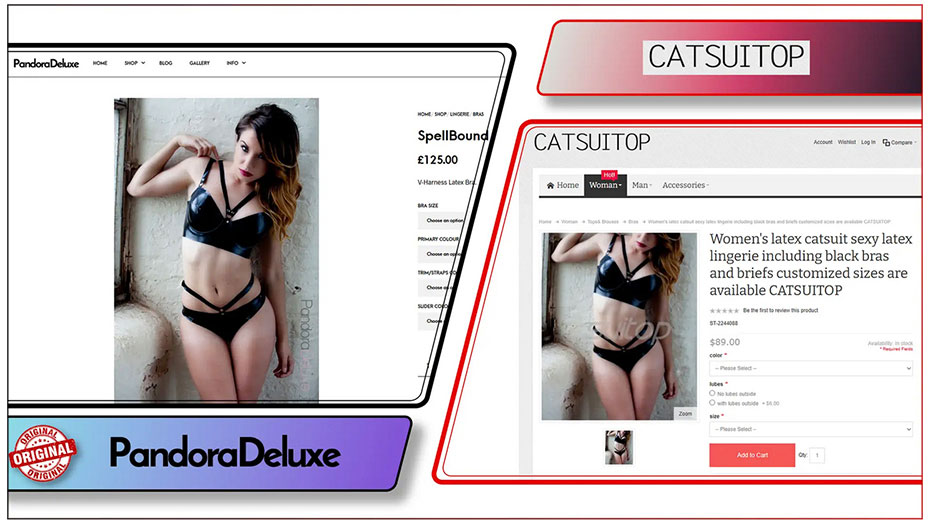
Which brings us back to the Latex 24/7 article. It provides a mass of evidence for which original latex designers are being copied by which Chinese brands. It does this individually for each of the Chinese brands it has investigated, using comparative visuals that pinpoint specific cases of copying that are impossible to deny. We have selected a few examples of these comparative visuals to illustrate our article, but there are many more in the original Latex 24/7 piece.
For your interest, here are few key facts we’ve extracted from Latex 24/7’s research in Chinese latex copying. Eleven Chinese brands and two alternative brands are covered in the survey. In A-Z order, they are: Catsuitop, Elite (Mitie) Latex, Fifade, Laidtex, Latex Charms, Latex Clothing UK (aka Latex Slogan), Latex Magic Best, Latexy (aka ShopLatexy), Lixe, MinimalLatex and MoonBunny Latex (not to be confused with Moon Bunny Boutique Latex).
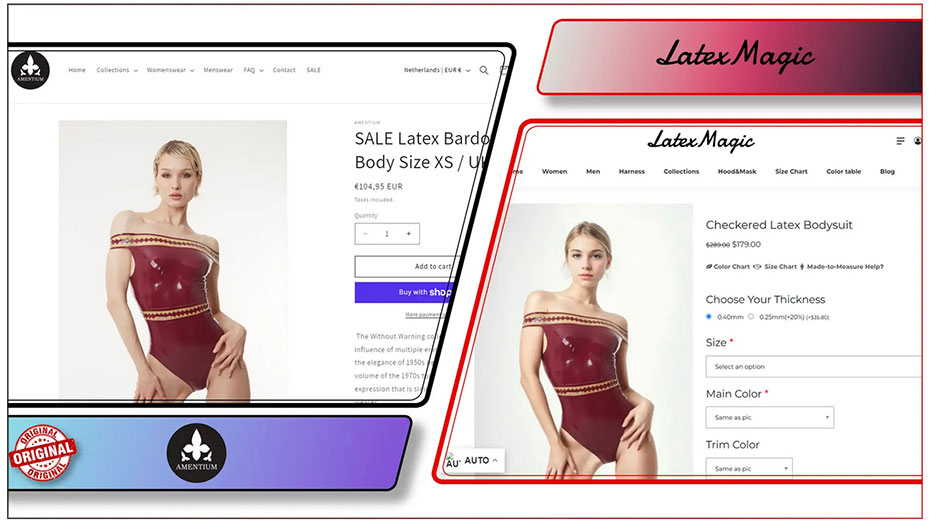
In Latex 24/7’s investigation of Chinese latex copying, Latex Magic Best, above right, was found to have copied the most original latex designers: 14 different brands, the vast majority of which are British, including Amentium, above left. Notice that here, Latex Magic has used face-swapping, a feature available with AI, to suggest its image is original, rather than stolen and modified (graphics c/o Latex 24/7)
The research reveals that between them, these Chinese brands had copied designs from at least 35 original latex labels. Most-copied designer in the research is Ukraine’s Bright And Shiny Latex label, which Latex247 found to have been copied by eight Chinese brands. After that comes Westward Bound (UK) — seven copyists; William Wilde (UK) — six copyists; Catalyst Latex (UK) and Lady Lucie Latex (UK) — both five copyists; ForniKation Latex (UK), Honour Clothing (UK), Libidex (UK), and Savage Wear (DE) — all with four copyists.
Other familiar latex brands which the research found to have been victims of Chinese latex copying include: Affordable Latex (UK), Amentium (UK), Chronomatic (DE), FBLS (IT), Kaori’s Latex Dreams (UK), Liquorish and Lace (UK), Pandora Deluxe (UK), Simon O (AT), Skin Two (UK) and Vex Clothing (USA).
The Latex 24/7 article concludes with some comprehensive advice on how to verify retailers, and a stark warning that the use of AI and photo manipulation is making latex copycat activities easier than ever to do and harder to spot which means potential customers need to take even more care now.
Read the full Latex 24/7 exposé of Chinese latex copying here!